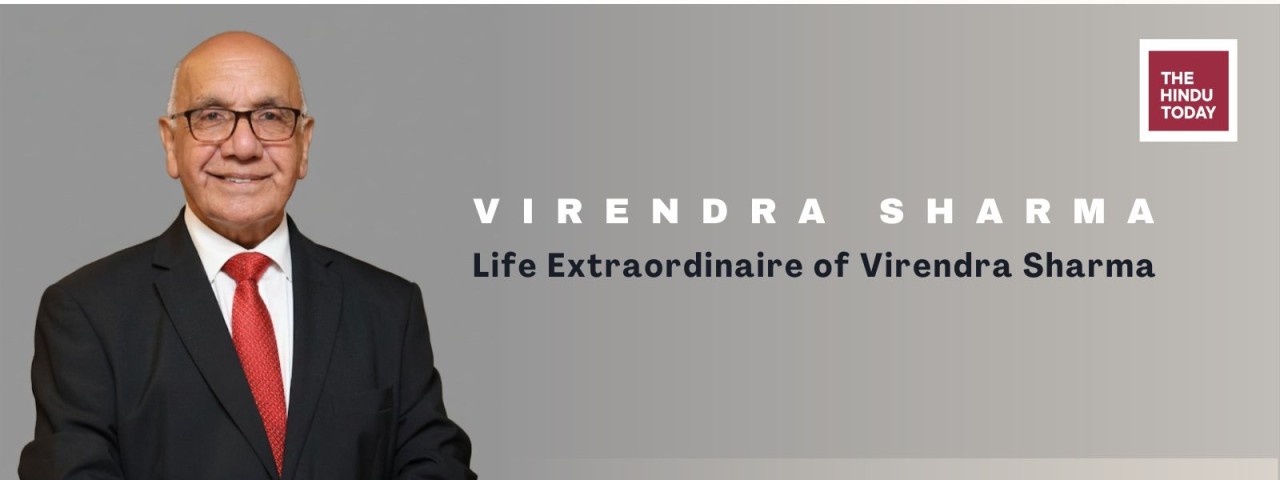
Life Extraordinaire of Virendra Sharma
(TEXT BEGINS)
Year: 1968
Place: London
Leave alone his passengers, even the 21-year-old man – Virendra Sharma – a bus conductor on route # 207 in West London had no clue whatsoever that half a century later he would retire as one of Britain’s most respected parliamentarians.
However, this comes as no surprise because Sharma’s father, Dr Lekh Raj Sharma, was a well-known political figure in Punjab, who till date is remembered for his commitment to reform and equity.
While Sharma who was born on April 5, 1947, in the village of Mandhali in Punjab, may have learnt the political ropes from his father, his mother helped shape his moral compass.
As Sharma completes more than five decades in public service, his legacy, one can say, is not confined to the South Asian community or to Labour politics. Besides, his life is a testament to Britain’s capacity for reinvention and inclusion: that an immigrant from rural India could rise to the corridors of Westminster, armed only with integrity, grit, and a relentless commitment to fairness.
Sharma, who studied in London School of Economics, is now grandfather to Aatish, Riah, and Jaiden. He has a son named Sanjeev and daughter Monica. His wife, Nirmala has been his steadfast support throughout his journey. He speaks English, Punjabi, Hindi and Urdu fluently.
Though Sharma’s career is synonymous with the Labour Party, his earliest political home was the Liberal Party. He later switched to Labour, serving as its Race Equalities Officer. In 1982, he was elected as a councillor in Ealing, beginning a political journey that would span more than four decades.
Over 25 years in local government, including a term as Mayor of Ealing, Sharma built a reputation for tireless community work. By the time he entered Parliament in 200– winning the Ealing Southall by-election after the unfortunate death of sitting Labour MP Piara Khabra – he had already become a household name in West London.
Even after stepping down, Sharma remains active. He recently returned from a month-long tour of India, leading a delegation of over 50 UK universities and educators to strengthen student partnerships – continuing his lifelong mission of bridge-building.
Every politician, rightly or wrongly, gets from time to time into some controversy and Sharma is no exception. But talks surrounding him centre mostly on his constituency politics. Like the controversy relating to the old dispute about the future of Southall Town Hall. Some local leaders say that the Hall might be taken over by a temple authority at Sharma's tacit support, but he strongly refutes the insinuations and charges.
'Both sides have good proposals and both want what is best for the community... I have maintained a position through the bidding processes for both options of neutrality, I will work with whichever proposal is finally successful to ensure our community is best served by Southall Town Hall,' asserts Sharma.
Sharma currently chairs the Indo-British All Party Parliamentary Group (APPG), leads the APPG for Gurkha Welfare, and is Co-Chair of the APPG on Nepal, the Tuberculosis Group, the Hepatitis Group. He is a member of the parliamentary select committees on Health, Human Rights and International Development, no less.
Whether advocating for Tamil rights or promoting Indo-UK relations, Sharma’s work crossed constituencies and continents.
Interestingly, when the Parliament was rocked by the expenses scandal in 2009, Sharma stood apart. Claiming less than he was entitled to, he earned a spot on The Telegraph’s list of Britain’s '50 Saints'—a rare badge of honour in political life.
Sharma never shied from divisive debates. A vocal critic of Brexit, he argued that leaving the EU would be 'detrimental' to Britain’s interests, championing a second referendum when the debate was at its fiercest.
On India–Pakistan relations, he was equally candid. Known for blunt criticism of Pakistan’s role in terrorism, Sharma won strong support from Britain’s Indian diaspora, even as some accused him of alienating parts of his multicultural constituency. Yet, he also welcomed peace initiatives, calling the Kartarpur Corridor 'a foundation stone for lasting friendship' between the two countries.
Far from stoking division, Sharma consistently sought to build harmony—sending greetings during Ramadan, urging patience and tolerance, and calling for greater empathy across faiths.
'I am not seen as a Hindu, but a Labour MP who happens to come from the Hindu faith,' he once said. His politics were rooted not in identity, but in equality and secularism.
Over the years, Sharma’s service has been recognised with honours including the Bharat Gaurav Award, Hind Rattan Award, Pride of Punjab Award, Parvasi Sansar Award, and India UK Achievers Honours.
 UK - English -
General
UK - English -
General